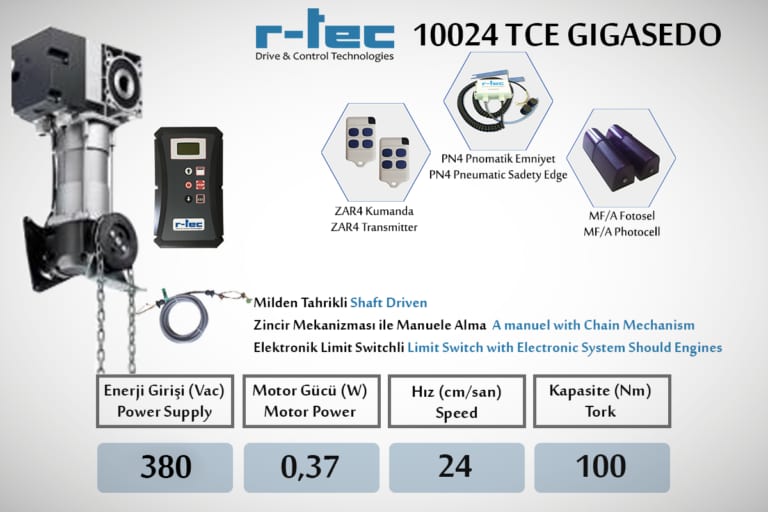




Technical files
Documents
Specifications and installation information can be viewed or downloaded as PDFs from our server.
Technical specifications
1Key technical specifications
The most critical technical parameters of this product.
- Mains voltage3 × 400V three-phase
- Motor outputU / V / W (inverter)
- Number of fuses4 (3 × T10A + T125mA)
- DisplayLCD + radio control module slot
- Password-protected menuFactory 0000 / user assignable (menu 2570)
- RS485 lines2 (RS485-1 + RS485-2)
Show all technical specifications (16)
Control
| Feature | Value |
|---|---|
| Induction loop | Available (with add-on board) |
| Traffic light | Available (with add-on board) |
| Extra relays | 3 (REL1 / REL2 / REL3) |
| Encoder connection | B / A / GND / +24 V (green / pink / white / brown) |
| Automatic closing minimum time | 5s |
Protection
| Feature | Value |
|---|---|
| Safety strip | 8.2 kΩ — 2 channels |
| Optical sensor (OSE) | 2 channels |
| Photocell | 2 (4-wire + 2-wire) |
| Motor thermal protection | Available (yellow + grey cable) |
| Service door switch | Stop switch connected by spiral cable |
Overview
GIGA Sedo sits at the top of r-tec’s industrial control portfolio. On the board you will find the German-origin Sommer Antriebs- und Funktechnik GmbH manufacturer label — the tangible result of r-tec’s European OEM partnership established after the 2014 Stuttgart fair. Its feature set reaches well beyond the standard I-380 direct-drive board, gathering an LCD screen + password menu, RS485 multi-door, induction loop, traffic light, 8K2 safety strip, 2 optical sensors and 2 photocells onto a single board.

Why Premium?
GIGA Sedo is not necessary in ordinary industrial door applications — I-380 is sufficient at most sites. Scenarios where the premium line adds value:
- Hangar-type wide-opening doors — 4700 × 10000 mm multi-leaf side-folding or telescopic (induction loop + traffic light used together).
- Logistics terminal + cargo distribution centre — Connects to the central control room with RS485, door status is live-monitored.
- Automotive production lines — Multi-safety layer is mandatory with 8K2 safety strip (European quality standard), two optical sensors + two photocells.
- Food + pharmaceutical warehouses — Compatible with hygiene inspection systems with service door switch + motor thermal protection.
- Sensitive industrial applications — Untrained intervention is prevented with the password-protected menu.
LCD menu + password protection
After commissioning, all parameters are navigated via the LCD screen. With 3 buttons (Back = Up, OK = Stop, Forward = Down), the multi-language menu is traversed.
Menu steps:
- Language selection (0200) — Turkish / English / German and others.
- Time setting (0300) — Time + date (used for logging).
- Motor direction check (0400) — Automatic motor direction detection.
- Limit setting (0500) — Upper limit (4027 default) + Lower limit (3222 default).
- Fine tuning of limits (0600) — Opening + closing fine tuning.
- Automatic closing — Minimum 5 s.
Password: Factory output 0000. Trained personnel change the password from menu 2570; persons other than dealer/technician teams coming to the site cannot intervene in the parameters.
I/O layers — ~80 clamps in total
The most distinct feature that differentiates GIGA Sedo from I-380 is its detailed I/O set. Clamp groups:
| Group | Clamp | Function |
|---|---|---|
| Limit switch | 1 – 6 | Opening / closing / pre-limit |
| Buttons | 7 – 14 | Open / Stop / Close / Impulse |
| Safety strip 8K2 | 17 – 20 | 2 channels 8.2 kΩ |
| Optical sensor (OSE) | 21 – 27 | 2 channels spiral cable tested |
| Photocell | 28 – 33 | 4-wire + 2-wire |
| Thermal + service switch | 34 – 37 | Motor thermal + spiral cable stop |
| Traffic light | 54 – 58 | Red / green add-on module |
| Induction loop | 59 – 63 | Underground vehicle detector |
| RS485-1 | 64 – 67 | Central system |
| Extra relays | 72 – 79 | Position and status notification |
| Motor inverter | 38 – 42 | U / V / W |
| Earth + neutral | 43 – 47 | PE + N |
| Three-phase | 48 – 50 | L1 / L2 / L3 |
4 fuse lines (F1/F2/F3 = T10A, F4 = T125mA) form the board protection layer.
Induction loop + traffic light — premium entrance
One of GIGA Sedo’s flagship features is fully smart entrance support for industrial terminals/logistics:
- Induction loop (add-on board required): An underground-embedded wire loop detects the vehicle passing over it. It opens the door automatically without the user pressing a button/remote — no manual intervention is required in logistics terminals with heavy truck traffic.
- Traffic light add-on board: Provides stop/go signal to the driver approaching the door. In the industrial terminal, it shows “STOP” to the approaching truck while the door is still closing, and “GO” signal engages when the door is fully open.
When used together, these two features form an autonomous entry control point — operator intervention is minimal.
RS485 multi-door / central control
Thanks to two RS485 lines (RS485-1 + RS485-2):
- Multi-door parallel control at the same facility (e.g. management of 5 hangar doors from a single central panel).
- Live door status monitoring + log recording (how many times the door was opened, at what time, how long it stayed open).
- Central control room integration — data exchange with SCADA / BMS systems.
Sommer Antriebs partnership — marketing story
The Sommer Antriebs- und Funktechnik GmbH label on the GIGA Sedo board shows that r-tec is a partner manufacturer to European quality standards. This partnership is the tangible result of the business relationship established at the 2014 Stuttgart fair; it confirms that r-tec has direct access to the German engineering supply chain.
Target projects
- Hangar-type automotive production facility
- Logistics terminal + cargo distribution centre
- Port and organised industrial zone entry control points
- Premium food + pharmaceutical warehouses
- Airport industrial service entrances (fire, maintenance, materials)
- High-precision production facilities (clean room, pharmaceutical, semiconductor)
Model notes
GIGA Sedo has a board structure that requires the motor shaft to rotate at least 1 turn before commissioning — the board must not be energised without bringing the door to the half-open position manually. Limit switch settings are made via the LCD menu in the 4027 (up) / 3222 (down) default value range; fine tuning is completed later via menu 0600. Password-protected use is recommended to prevent untrained intervention.
Installation and Commissioning
GIGA Sedo is a premium industrial control; commissioning is done by defining parameters through the LCD menu and it offers advanced integration options. General flow:
- Preparation before power-up: By the board’s design the motor shaft must be able to turn at least one revolution, so the board is not energised before the door is moved by hand to the half-open position.
- Supply and motor: The supply, motor and encoder connections are made; when the LCD is active, the status and event history (history menu) are accessible via the menu.
- Parameter definition: Door type, speed, limit and protection parameters are defined from the LCD menu; error messages appear on the display as readable text (for example “PHASE LOSS”, “ENCODER FAIL”).
- Integration: Remote reading over RS485 and access-control accessories such as an induction-loop detector are configured.
- Test: Parameters are verified over a few cycles; the message-meaning table is matched from the guide.
Parameter and integration settings must be made only by trained personnel, per the model guide.
Frequently Asked Questions
Below we've compiled the most common questions and answers regarding this product.
GIGA SEDO panel LCD shows an error message or is off
GIGA SEDO premium industrial control keeps readable error messages on the LCD display (e.g., "PHASE LOSS", "ENCODER FAIL", "CONTACTOR FAIL"). If the LCD is completely off, this is a supply or LCD backlight issue. Initial intervention: photograph the error message for record, match it from the message-meaning table in the guide, read the event history (history menu) on the board. If an RS485 connection is present, support can be obtained via remote reading. In case of burn or component suspicion, no manipulation should be performed on the board.
Other LEDs are lit on the r-tec board but the processor LED is off
Cause: the microprocessor may have gone into self-protection after a momentary voltage/current fluctuation. First step: cut the power, wait until all LEDs on the board go off completely, then re-apply power (reset). If the processor LED still does not light and the board does not respond to commands, the microprocessor has failed; the board must be assessed or replaced by authorized service. Do not intervene on the board in this case.
Contact our team for model-specific information or a quote.