


Documents
All documents open as PDFs in a new tab.
Brochures
2Technical specifications
1Dimensioning forms
4Installation guides
1User manuals
1Declarations and conformity records
2Key technical specifications
The most critical technical parameters of this product.
- Panel thickness 40 mm
- Core Polyurethane 40 kg/m³
- Galvanised sheet thickness 0.40 mm
- Panel heat-transfer entry, specification reference 0.604; printed unit ambiguous, not verified as a complete-door U-value
- Panel sound insulation (R'w), specification reference 26 dB
- Water tightness Technical-specification requirement: EN 12425 Class 2
Show all technical specifications (15)
Mechanical
| Feature | Value |
|---|---|
| Track types | Standard / Vertical / High-lift / FHL roof-pitch |
| Torsion spring life | 15,000 standard · 25,000 / 50,000 / 100,000 optional |
| Steel lifting cable | 6×19 wire · 200 kg/mm² tensile strength |
Colour
| Feature | Value |
|---|---|
| Standard colour | RAL 9002 standard; other RAL colours on request |
Dimensions
| Feature | Value |
|---|---|
| Reference max. width | 8,000 mm |
| Reference max. height | 7,000 mm |
| Service door (optional) | 840 × 1840 mm (width ≤ 5,000 mm) |
Panel
| Feature | Value |
|---|---|
| Panel height options | 460 / 500 / 560 / 610 mm |
Insulation
| Feature | Value |
|---|---|
| Weather seal | EPDM · flexible down to -30 °C |
Videos
Installation and support guides
These videos demonstrate the model and control board shown. They may provide general reference for other products; use the current technical manual for the relevant model for connections and settings.
I-380 control unit 6 videos
Run-time learning, photocell, pneumatic safety, loop detector and receiver.
For systems using I-380; this is not a door mechanical installation manual.
Turkish video archive from the Alkur YouTube channel; titles and topic notes are translated.
System / board reference
An overview of the I 380 industrial door control board and its main connection points.
- 3:54 Watch on YouTube
An overview of the I 380 industrial door control board and its main connection points.
- 0:36 Watch on YouTube
A short guide to connecting a pneumatic safety edge to the I 380 control board.
- 1:17 Watch on YouTube
A technical demonstration of connecting a safety photocell to the I 380 control board.
- 0:59 Watch on YouTube
An example of connecting a vehicle-detection loop detector to the I 380 control board.
- 0:56 Watch on YouTube
A guide to connecting an external remote-control receiver to the I 380 control board.
- 1:24 Watch on YouTube
A demonstration of programming the motor run time on the I 380 controller.
Overview
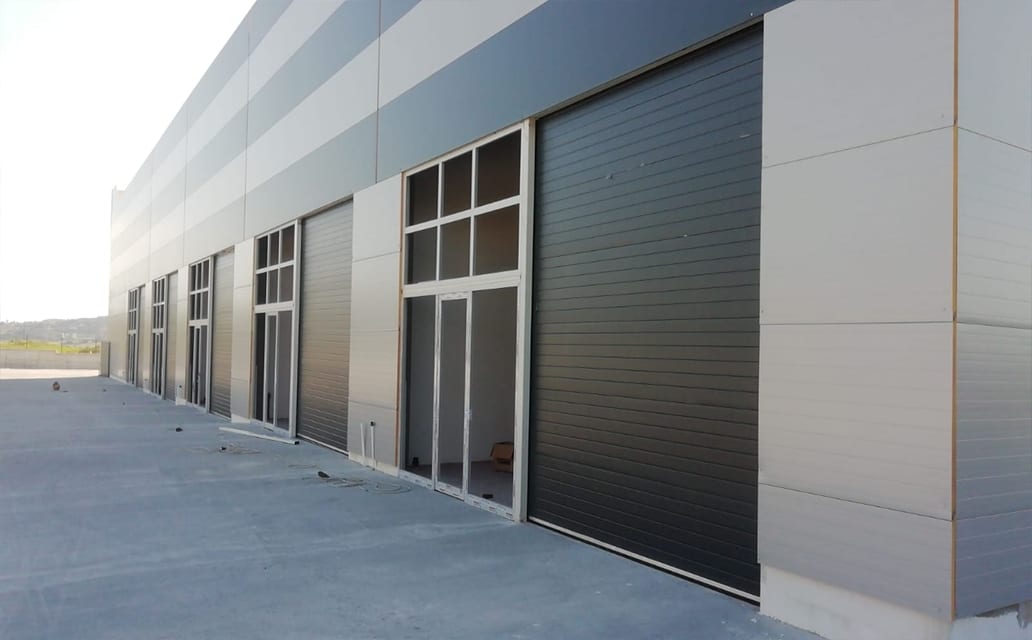
Industrial sectional doors are solutions that provide high insulation and safety suited to the wide product and vehicle transit of industrial and storage facilities. Hinges and wheels mounted on both edges of the panels move on the side rails; steel cables wound onto the drum and the power of the torsion springs ease the door movement. Through the correct track type selection, the height loss at the transit point is minimised.
Operating principle
The lift type describes the door’s opening path. Standard lift takes the leaf back under the ceiling; high lift first raises it vertically; vertical lift takes it entirely upwards. FHL tracks follow the roof pitch. Suitability is assessed by measuring headroom, side space, motor position and obstructions such as beams and services together.
Typical use
Production lines, logistics warehouses, cold storage, automotive supplier facilities and service entrances are typical application areas. In shift operations, the motor, spring life and safety equipment are selected from the real daily and peak-hour cycle profile. Finger-safe panels, photocells and safety edges are configured together with the project risk assessment.
Advantages
- High insulation: double-skinned 40 mm polyurethane-filled panels contribute to thermal/sound insulation.
- Flexible configuration: customisation according to ceiling-beam dimensions with 4 different track types.
- Traceable evidence scope: the SP test report is published with its exact current evidence scope; the 2020 EC copy, Domestic Product record expired in 2024 and EAC record expired in 2020 are separately labelled as archive documents.
- Full document set: technical specification, dimension verification forms for 4 tracks and the installation guide can be downloaded as PDF from above.
Selecting the lift type and dimensions
The published industrial size forms give the references below. H is clear passage height, HR is headroom and HL is the high-lift dimension. These references do not replace project size confirmation.
| Lift type | Geometry recorded on the form |
|---|---|
| Standard | HR = 400 mm; room for horizontal tracks beneath the ceiling |
| High | HR = HL + 350 mm; vertical rise followed by horizontal tracks |
| Vertical | HR = H + 350 mm; space for the leaf to rise entirely upwards |
| FHL | HR, HL and roof angle X together; a track path following the slope |
All four forms show the M = 300 mm motor bracket as a horizontal dimension. It does not mean another 300 mm of vertical headroom for FHL. The lift selection guide and measurement preparation guide explain these terms.
Panel values and complete-door performance
The REV04 English panel line prints 0.604 k (W/m²). The unit is ambiguous; verify the current manufacturer declaration before using this as a definite panel or complete-door U-value. The specification’s R’w = 26 dB line is a panel reference; assess the proposed door configuration separately. PDF. They are not the same measured result for every complete door with different dimensions, windows, wicket doors and perimeter seals. Panel selection and the required complete-door performance scope are specified separately in the quotation.
The 2021 Turkish section of the specification describes an 840 × 1840 mm wicket door for door widths up to 5,000 mm, and windows for widths up to 6,000 mm. A wicket door or window request is recorded on the size form and checked against the quoted configuration.
SP report 3P00659B, dated 12 February 2013, records air permeability class 2 and wind-load resistance class 3 for a 6040 × 3500 mm Alkur Normtor industrial-door specimen. This historical result applies only to the reinforced specimen described in the report, not every size in the range or a current quoted configuration.
What is needed before a quotation?
Record clear passage width and height, headroom, separate side clearances, motor side and overhead obstructions on the form. Daily and peak-hour cycles and the power supply also inform motor and spring selection. This information goes through the dealer, distributor or partner handling the project.
Where transit speed is a priority, the sectional and high-speed PVC comparison supports the product choice.
In which sectors is it used?
This product family is preferred in the sectors and application areas below.
- Logistics and storage
- Production facility
- Automotive spare parts
- Distribution centre
- Cold chain
Frequently Asked Questions
Below we've compiled the most common questions and answers regarding this product.
-
Which panel thickness should I choose?
The standard configuration describes a 40 mm sandwich panel. The REV04 English panel line prints 0.604 k (W/m²). The unit is ambiguous; verify the current manufacturer declaration before using this as a definite panel or complete-door U-value. The specification’s R'w = 26 dB line is a panel reference; assess the proposed door configuration separately.
-
Is production outside standard sizes possible?
Yes. The NORMTOR sectional door can be produced to meet your project-specific custom size requests. For non-standard sizes, an engineering approval process is carried out first (panel/profile suitability + motor selection); sharing the clear opening, lintel and side clearance at the quotation stage speeds up the process.
-
Can the motor option be changed?
Motor and controller are selected for the project's door dimensions, duty and mains supply. The 220-K manual describes 380 V three-phase contactor control; it is not a 220 V single-phase option. Confirm whether FU or another controller pairs with the selected motor against the model manuals for that configuration.
-
Are a declaration of conformity and a test report the same document?
No. A declaration of conformity states the product type and standards scope declared by the manufacturer; it is not a performance test report. Test results are limited to the defined specimen and test conditions. Verify the dimensions and components of the offered door against the scope of the relevant documents.
-
Is there a maintenance and service contract?
Alkur is a B2B manufacturer; all sales, product supply and after-sales processes are handled through dealers, distributors and business partners. Alkur does not sell products or provide services or technical support directly to end users. Maintenance and repair are performed by the authorised technical teams running the project. If you are an end user, please first contact the partner dealer that installed your system, then, if needed, our partners in your city, district, region or country. As manufacturer, we support those teams with technical documentation, parts-compatibility guidance and original spare-parts supply; requests requiring manufacturer assessment are forwarded through the dealer, distributor or business partner. The maintenance-contract scope is agreed with the relevant dealer or project team.