



Technical files
Documents
Specifications and installation information can be viewed or downloaded as PDFs from our server.
Technical documents
2Key technical specifications
The most critical technical parameters of this product.
- Operating principle Mechanical pneumatic pressure switch (electricity-free)
- Output NO + NC dry contact
- Contact load 0.5 A / 250 VAC
- Switch speed max. 10 /sec
- Pressure capacity 20 mbar
- Band length Max 3 m (site-based)
Show all technical specifications (8)
Mechanical
| Feature | Value |
|---|---|
| Operating temperature | -20 – +70 °C |
Certification
| Feature | Value |
|---|---|
| Safety class | CE EN 12453 |
Videos
You can find all of our product and installation videos on our YouTube channel.
Visit Our YouTube ChannelOverview
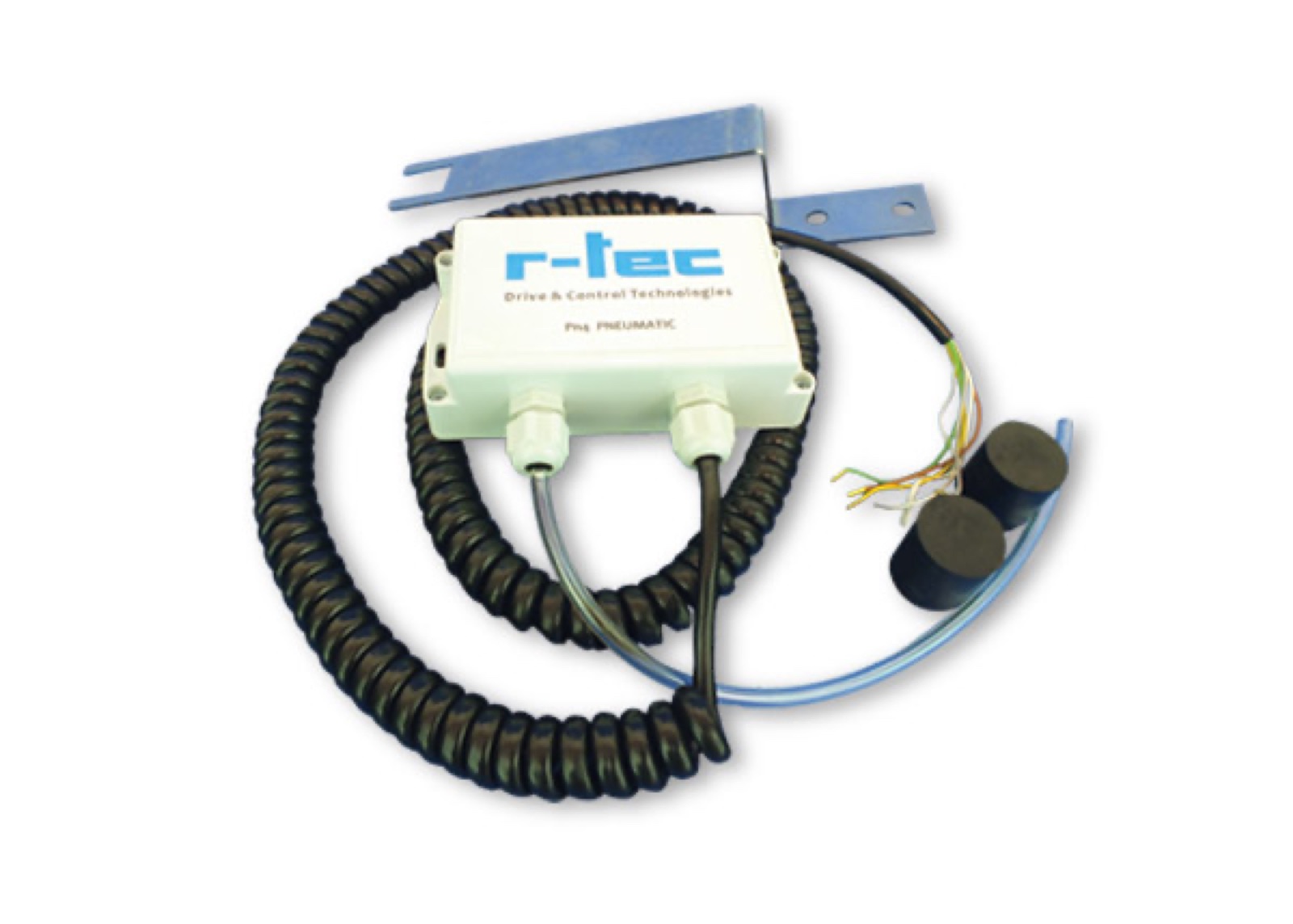
r-tec PN4 Pneumatic Control Module provides pneumatic edge safety band control for automatic doors, industrial sectional and barriers. When an object is pinched in the air-filled soft band on the door/leaf bottom edge, it detects the pressure change and instantly stops the motor. It is a mandatory accessory within the CE EN 12453 safety class.
How does it work?
- Pneumatic band is attached to the door/leaf bottom edge
- Band is filled with air (4-6 mbar low pressure)
- PN4 module continuously monitors band pressure
- When object/person pinched → band crushes → pressure drops
- PN4 raises alarm → motor stop signal
Advantage: Detects low objects (foot, pet, child) that photocells cannot detect. Photocell + PN4 combination = full perimeter protection.
Photocell vs PN4 — difference
| Detection type | Photocell | PN4 Pneumatic |
|---|---|---|
| Principle | Optical (beam break) | Mechanical (pressure) |
| Position | Side walls | Door/leaf edge |
| Detection | Entire object | At time of pinch |
| Height | At certain height | All heights |
| False alarm | Can occur in dust | Low (mechanical) |
| Compliance | Standard | CE EN 12453 mandatory |
→ PN4 must always be used at sites with child and pet risk. Photocells cannot detect the lower 30-50 cm of the door; PN4 fills the gap.
Target projects
- Automatic door (hospital, mall, office — child + elderly at risk)
- Industrial sectional door (forklift operator protection)
- Barrier (low vehicle + bicycle protection)
- Garage door (child + pet protection)
- Automatic sliding glass doors (busy pedestrian entries)
- Cold storage door (operator protection)
Field discipline
- Band tension calibration — Band is set to 4-6 mbar pressure during first commissioning
- Band sensitivity — Too tight = false alarm; too loose = pinch not detected
- Band check — Visual check every 6 months; worn/punctured band renewed
- Winter cold — Band flexibility decreases below -20 °C; tight calibration done
- Periodic test — Monthly manual test (squeeze band → did motor stop?) mandatory
- CE certificate site — Module + band + certificate file kept on site (for audit)
Frequently Asked Questions
Below we've compiled the most common questions and answers regarding this product.
-
How does pneumatic edge protection work and why is it not electrical?
There is a volume of air inside the strip; when the leaf contacts an object the strip is compressed, the pressure inside rises, and a mechanical pressure switch breaks the circuit at 20 mbar. Detection is entirely mechanical, with no electricity on the strip side. That brings two benefits: in wet and dusty environments the strip itself is not a source of electrical faults, and contact detection does not depend on a sensor's field of view. The output gives normally open and normally closed dry contacts, with the contact rating limited to 0.5 A at 250 VAC. Strip length is made up to a maximum of 3 m according to the site dimension.
-
Does edge protection replace a photocell?
It does not, it completes it. A photocell detects an object on the beam line before contact; edge protection acts once contact has occurred. The two cover different scenarios: a low object below the beam line, or a pedestrian approaching from outside the beam path, may go unseen by the photocell, and the strip stopping the door on contact is the last line. This is why the CE EN 12453 safety class requirement calls for both layers together in most applications. Switch rate is given as at most 10 operations per second, and it works between -20 and +70 °C.
Contact our team for model-specific information or a quote.