






Technical files
Documents
Specifications and installation information can be viewed or downloaded as PDFs from our server.
Technical documents
1Key technical specifications
The most critical technical parameters of this product.
- Power supply 230 VAC 50 Hz
- Motor voltage 24 VDC
- Motor power 120 W
- Maximum leaf length (2024 manual) 4 m
- Protection class IP44
- Control unit G24
Videos
Installation and support guides
These videos demonstrate the model and control board shown. They may provide general reference for other products; use the current technical manual for the relevant model for connections and settings.
24 V swing gates 8 videos
GATE24/G24A board, motor and limit learning; safety and remote control connections.
Reference for the 24 V motor and GATE24/G24 board shown; not for 220 V motors.
Turkish video archive from the Alkur YouTube channel; titles and topic notes are translated.
System / board reference
An overview of the G24A control board, its connection points and adjustment controls.
- 5:14 Watch on YouTube
An overview of the G24A control board, its connection points and adjustment controls.
- 5:04 Watch on YouTube
A demonstration of connecting a 24 V swing gate motor to the GATE24 controller.
- 2:21 Watch on YouTube
A guide to programming opening and closing limits on a 24 V swing gate motor.
- 1:41 Watch on YouTube
A technical demonstration of connecting a safety photocell to the G24 control board.
- 0:24 Watch on YouTube
A short guide to connecting a warning flasher to the G24 control board.
- 1:01 Watch on YouTube
An example of connecting a vehicle-detection loop detector to the G24 control board.
- 0:48 Watch on YouTube
A demonstration of pairing a Fix Code remote control and clearing stored remote-control entries.
- 1:07 Watch on YouTube
A demonstration of connecting an external remote-control receiver to the G24 control board.
Product and document scope
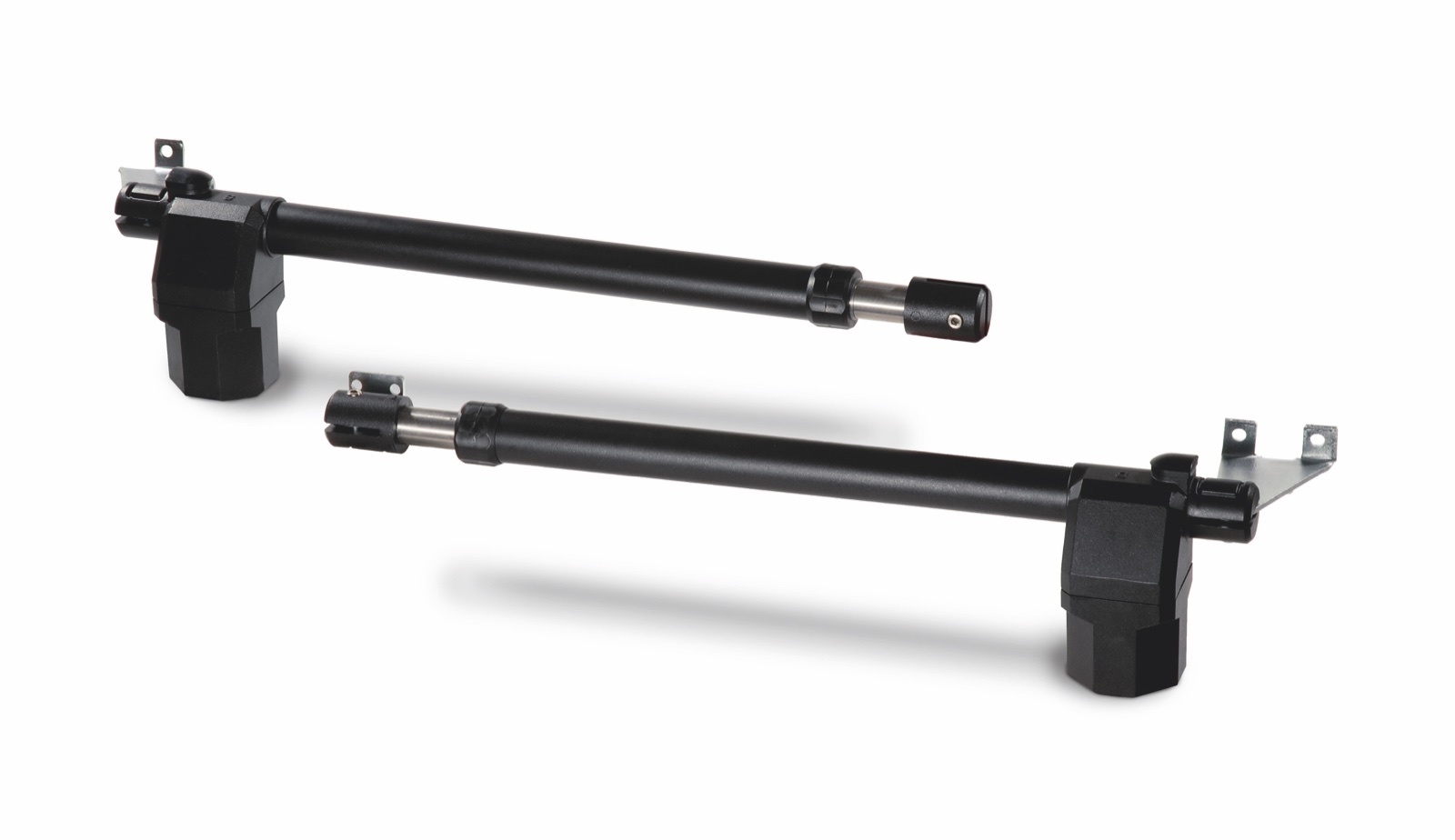
PRINCE 600 is the telescopic-arm swing-gate operator listed alongside PRINCE 400 in a shared installation manual. The PRINCE 600 column of the 2024 PRINCE 400/600 PDF gives a 24 V DC motor, 120 W, a maximum 4 m leaf length and 600 kg gate weight. It also lists motor dimensions of 920 × 100 × 110 mm, IP44 and an operating range of −20 °C to +55 °C. Keep these figures with the PRINCE 600 column and check the label on the actual unit; do not transfer them to PRINCE 400.
Compared with PRINCE 400
The shared manual lists 3 m / 400 kg for PRINCE 400 and 4 m / 600 kg for PRINCE 600. Both motor-power rows read 120 W, but equal power does not establish equal leaf capacity. The PDF does not explain the difference through a particular torque or arm-geometry calculation. Dimensions differ too: 820 × 100 × 110 mm for PRINCE 400 and 920 × 100 × 110 mm for PRINCE 600.
G24 board and battery scope
The G24 diagram in the installation PDF labels terminals 62/63 for a 24 V battery. It also shows a driver board for a second motor and photocell inputs. These are board connection options; the drawing does not prove that a battery or extra board is supplied with every PRINCE 600 kit. Battery capacity, outage-cycle count and the compatible battery model require separate manufacturer confirmation.
Installation and service
Leaf length and weight alone are not enough: hinges, mounting points and the arm movement on site must be assessed. The manual gives no fixed 90° / 100° / 110° opening-angle choices or 6–12 month liquid-grease service schedule. Its speed row is printed with the unit m/sec, so we do not silently reinterpret it as cm/s. Use current manufacturer instructions matched to the exact operator and board revision for installation, limit learning and service.
In which sectors is it used?
This product family is preferred in the sectors and application areas below.
- Corporate campus entrance
- Wide-leaf private property entrance
- Production facility yard
Frequently Asked Questions
Below we've compiled the most common questions and answers regarding this product.
-
How do you choose between PRINCE 400 and PRINCE 600?
Some capacity or performance values differ between the available local documents. Do not select the model from a single disputed figure. Match the model label to a current manufacturer document before installation, then verify leaf weight, dimensions and duty on site.
-
What else matters when selecting a motor for a long leaf?
Wind load, leaf sag and hinge geometry affect motor selection. Inspect the leaf mechanics and site dimensions first, then use the current document for the exact model to confirm permitted dimensions.
Contact our team for model-specific information or a quote.