






Quick selection
Models 4
Click on a model to view its technical page. Technical documents are provided as PDFs on this site.
Documents
All documents open as PDFs in a new tab.
Technical specifications
1User manuals
2Key technical specifications
The most critical technical parameters of this product.
- Control unit R2 (r-tec)
- Mains voltage 230 VAC
- Motor voltage 24 VDC
- Power 100 W
- Current 2 – 6 A
- Protection class IP23
Show all technical specifications (13)
Mechanical
| Feature | Value |
|---|---|
| Leaf weight — double-leaf | 120 + 120 kg |
| Leaf weight — single-leaf | 150 kg |
Performance
| Feature | Value |
|---|---|
| Opening speed — single-leaf | 90 cm/s |
| Opening speed — double-leaf | 180 cm/s |
| Closing speed | 70% of the opening speed |
| Hold-open time (2015 general specification) | 0 – 90 s |
Control
| Feature | Value |
|---|---|
| Operation modes | 5 (Hold open / Partial / One-way / Automatic / Hold closed) |
Videos
Installation and support guides
These videos demonstrate the model and control board shown. They may provide general reference for other products; use the current technical manual for the relevant model for connections and settings.
Automatic pedestrian doors 7 videos
Control board, limit and parameter settings; locks, hand sensors and accessories.
Based on the door mechanism and board shown; connections need verification for other versions.
Turkish video archive from the Alkur YouTube channel; titles and topic notes are translated.
System / board reference
An overview of the automatic pedestrian door control board and its connection points.
- 4:58 Watch on YouTube
An overview of the automatic pedestrian door control board and its connection points.
- 0:35 Watch on YouTube
A short technical guide to accessory connections on the automatic pedestrian door control board.
- 1:00 Watch on YouTube
A demonstration of travel-limit learning on an automatic pedestrian door.
- 2:25 Watch on YouTube
A guide to adjusting operating parameters on the automatic pedestrian door control board.
- 0:24 Watch on YouTube
A short demonstration of connecting an electric lock to the automatic pedestrian door control board.
- 0:49 Watch on YouTube
An example of connecting a keypad access-control device to the automatic pedestrian door control board.
- 0:51 Watch on YouTube
A guide to connecting a touchless hand sensor to the automatic pedestrian door control board.
Overview
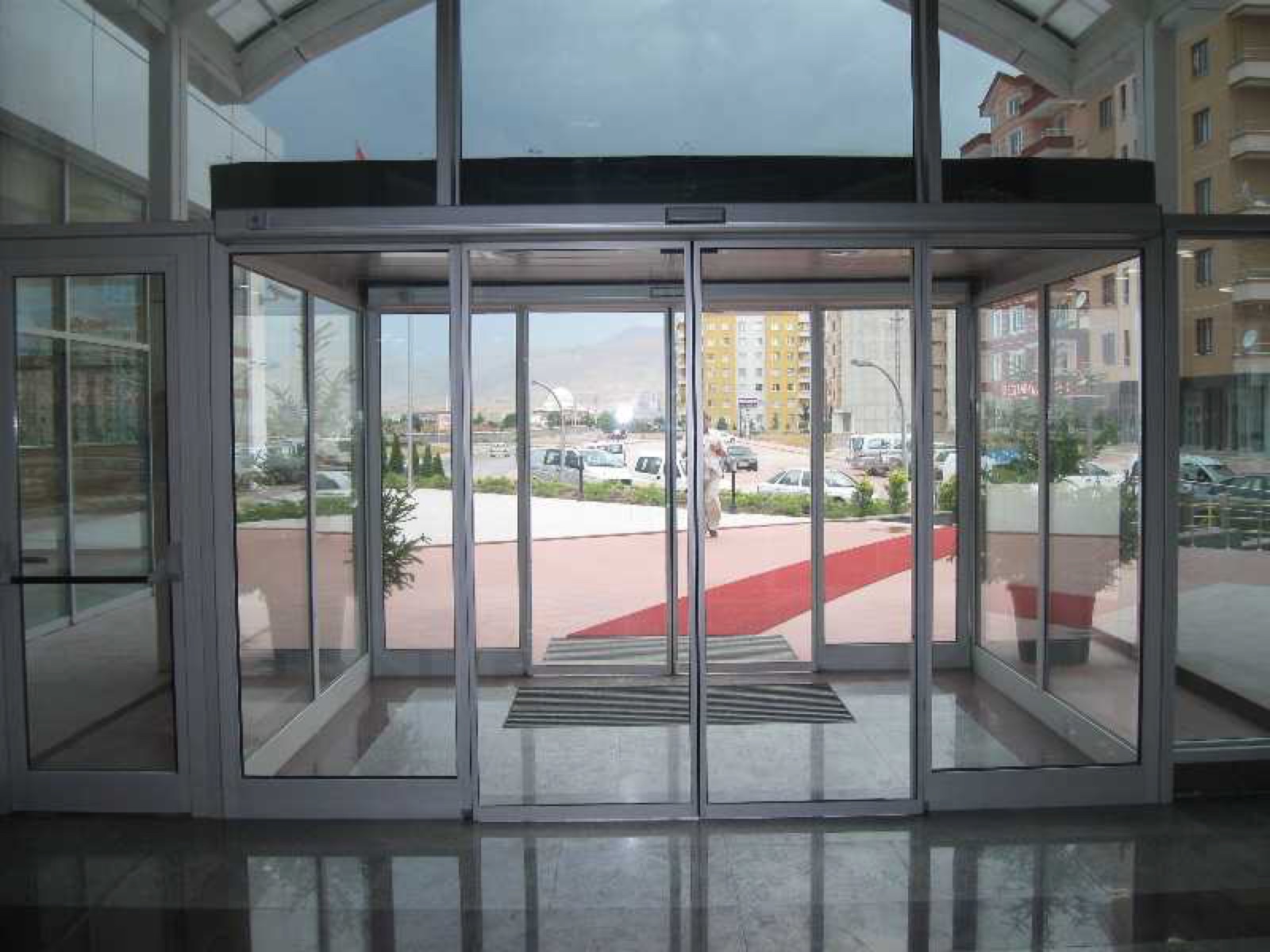
r-tec automatic door systems can be assessed for pedestrian entrances at shopping centres, hospitals, office lobbies, banks, hotels and airports. The documents mention standard and telescopic chassis and a hermetic spare profile; the profile alone does not establish an approved door type or sealing class. Four door types are mentioned: double-leaf sliding, single-leaf sliding, telescopic and revolving. Match R2 control information to the exact document for the selected type.
Chassis options
Standard chassis — Used in single-leaf or double-leaf sliding applications. Common in standard pedestrian transits such as office lobbies, shopping centre entrance doors, bank branches.
Telescopic chassis — leaves slide behind one another. This brochure gives no telescopic load, speed or maximum-opening table; request the exact model document.
Hermetic profile — This appears in the spare-parts list. No sealing or insulation class is given; a clean-room project needs an approved exact-model document.
Four door types
| Type | Max. leaf weight | Opening speed | Typical application |
|---|---|---|---|
| Double-leaf sliding | 120 + 120 kg | 180 cm/s | Shopping centre, hospital, office main entrance |
| Single-leaf sliding | 150 kg | 90 cm/s | Bank branch, small shop, personal entrance |
| Telescopic | Exact model document needed | Exact model document needed | Limited side-wall space |
| Revolving | (Per model) | (Per model) | Hotel lobby, premium commercial entrance |
R2 control unit
The R2 guide describes a control board for an automatic-door mechanism. The documented arrangement has 230 VAC mains and a 24 VDC motor; these are not alternative supply options. Highlighted functions:
- 23 parameters — Opening/closing deceleration distance, hold-open time, operating speed, closing-speed ratio, opening ramp, partial opening percentage, pushing force, etc. Fine adjustment for every site condition.
- 12 display codes — o1–o9, 10, 11 and St cover button, radar, photocell, encoder, current, supply and service states. A code alone does not establish the exact fault cause.
- 5 operation modes — Selector switch transitions:
- Hold open — The door is kept open.
- Partial opening — The R2 guide’s o5 parameter offers 25%, 50% or 75%; choose the setting for the project.
- One-way exit — The one-way operating mode listed in the R2 guide.
- Automatic (standard) — Normal operation triggered by photocell/sensor.
- Hold closed — The door is kept closed; electric-lock operation is configured separately.
The qualified technical team verifies the selected mode and safety devices on the installed door. A mode name alone does not establish suitability for an evacuation application.
Speed and safety
The R2 guide gives 90 cm/s opening speed for a single sliding leaf, 180 cm/s for two leaves and closing speed at 70% of opening speed. That ratio alone does not prove trapping protection. Its t1 parameter table gives a 0–60 s hold-open range; 0–90 s in the separate 2015 general specification has a different document scope and does not automatically apply to every R2 revision.
Archived document records and evidence boundary
TÜV Austria record 16-PS-0009-TAT-21-MAD-2479 identifies the product as AUTOMATIC DOOR and the type/model scope as r-tec, open, con-tech. The document was renewed on 12 February 2021 and expired on 12 February 2022. This archived record does not separately name sliding, telescopic or revolving variants, the R2 control unit, or the four door types on this page as its scope.
Domestic Product record 20221188100201, issued through SATSO / TOBB, identifies the product only as AUTOMATIC DOOR and states a 100% domestic contribution rate. It was valid from 8 September 2022 to 8 September 2023 and is now an archive record; it gives no separate scope or cost breakdown for the motor, control board, mechanical assembly or electronic components.
Neither historical record is evidence of a current certificate or current production ratio. The proposed model, control unit, equipment and current conformity file are verified separately for each project.
Target projects
- Shopping centre and plaza main entrance doors
- Hospital pedestrian entrance (verify the selected model against the project)
- Bank branch, currency exchange office, jeweller (secured pedestrian access)
- Hotel lobby and restaurant main entrance (revolving door)
- Airport terminal pedestrian transits
- Office towers and plaza lobby
- Pharmacy, market and retail store entrance doors
Service and spare parts
Page 15 of the R2 manual lists components such as chassis profiles and the control board; the exploded drawing on page 16 numbers 20 assembly parts. Neither is a current-stock promise or a compatibility approval for every door type. Confirm installation, maintenance and replacement-part suitability with the authorised technical team responsible for the project.
In which sectors is it used?
This product family is preferred in the sectors and application areas below.
- Shopping centre and store entrance
- Hospital and healthcare facility
- Hotel and hospitality
- Office building lobby
- Hygiene passage in food production
Frequently Asked Questions
Below we've compiled the most common questions and answers regarding this product.
-
What do the error codes (o2, o5, o8, 10, etc.) on the R2 automatic door display mean?
The R2 guide's page 13 table lists o1/o2 jamming, o3 overcurrent protection, o4 button, o5 radar, o6 mechanical jamming, o7 low battery, o8 photocell, o9 low mains voltage, 10 encoder, 11 high-current protection lasting over five seconds, and St service-time warnings. A code alone does not establish the exact cause. The 1-2-3 sequence after power-up relates to limit learning; if movement does not start or the sequence persists, trained personnel should inspect the mechanical installation. Investigate a jam instead of merely clearing its code.
-
The automatic door does not stop at the closing end and keeps re-learning its limits?
On page 14, the R2 guide says C4 push force may be too high when the 1-2-3 sequence reappears after the closing limit. For that specific case, it describes reducing C4 by 5 units and cycling power. The installation and cause of any jam still need checking; only trained personnel should change parameters within the model's stated range.