






Technical files
Documents
Specifications and installation information can be viewed or downloaded as PDFs from our server.
User manuals
2Key technical specifications
The most critical technical parameters of this product.
- Mains voltage 230 VAC
- Motor voltage 24 VDC
- Power 100 W
- Current 2 – 6 A
- Protection class IP23
- Double-leaf — leaf weight 120 + 120 kg
Show all technical specifications (16)
Mechanical
| Feature | Value |
|---|---|
| Single-leaf — leaf weight | 150 kg |
| Chassis type | Standard; verify telescopic variant separately |
Performance
| Feature | Value |
|---|---|
| Opening speed — single-leaf | 90 cm/s |
| Opening speed — double-leaf | 180 cm/s |
| Closing speed | 70% of the opening speed |
| Hold-open time | 0 – 60 s |
Control
| Feature | Value |
|---|---|
| Control unit | R2 (r-tec) |
| Number of parameters | 23 |
| Number of fault codes | 12 |
| Number of operation modes | 5 |
Videos
Installation and support guides
These videos demonstrate the model and control board shown. They may provide general reference for other products; use the current technical manual for the relevant model for connections and settings.
Automatic pedestrian doors 7 videos
Control board, limit and parameter settings; locks, hand sensors and accessories.
Based on the door mechanism and board shown; connections need verification for other versions.
Turkish video archive from the Alkur YouTube channel; titles and topic notes are translated.
System / board reference
An overview of the automatic pedestrian door control board and its connection points.
- 4:58 Watch on YouTube
An overview of the automatic pedestrian door control board and its connection points.
- 0:35 Watch on YouTube
A short technical guide to accessory connections on the automatic pedestrian door control board.
- 1:00 Watch on YouTube
A demonstration of travel-limit learning on an automatic pedestrian door.
- 2:25 Watch on YouTube
A guide to adjusting operating parameters on the automatic pedestrian door control board.
- 0:24 Watch on YouTube
A short demonstration of connecting an electric lock to the automatic pedestrian door control board.
- 0:49 Watch on YouTube
An example of connecting a keypad access-control device to the automatic pedestrian door control board.
- 0:51 Watch on YouTube
A guide to connecting a touchless hand sensor to the automatic pedestrian door control board.
Overview
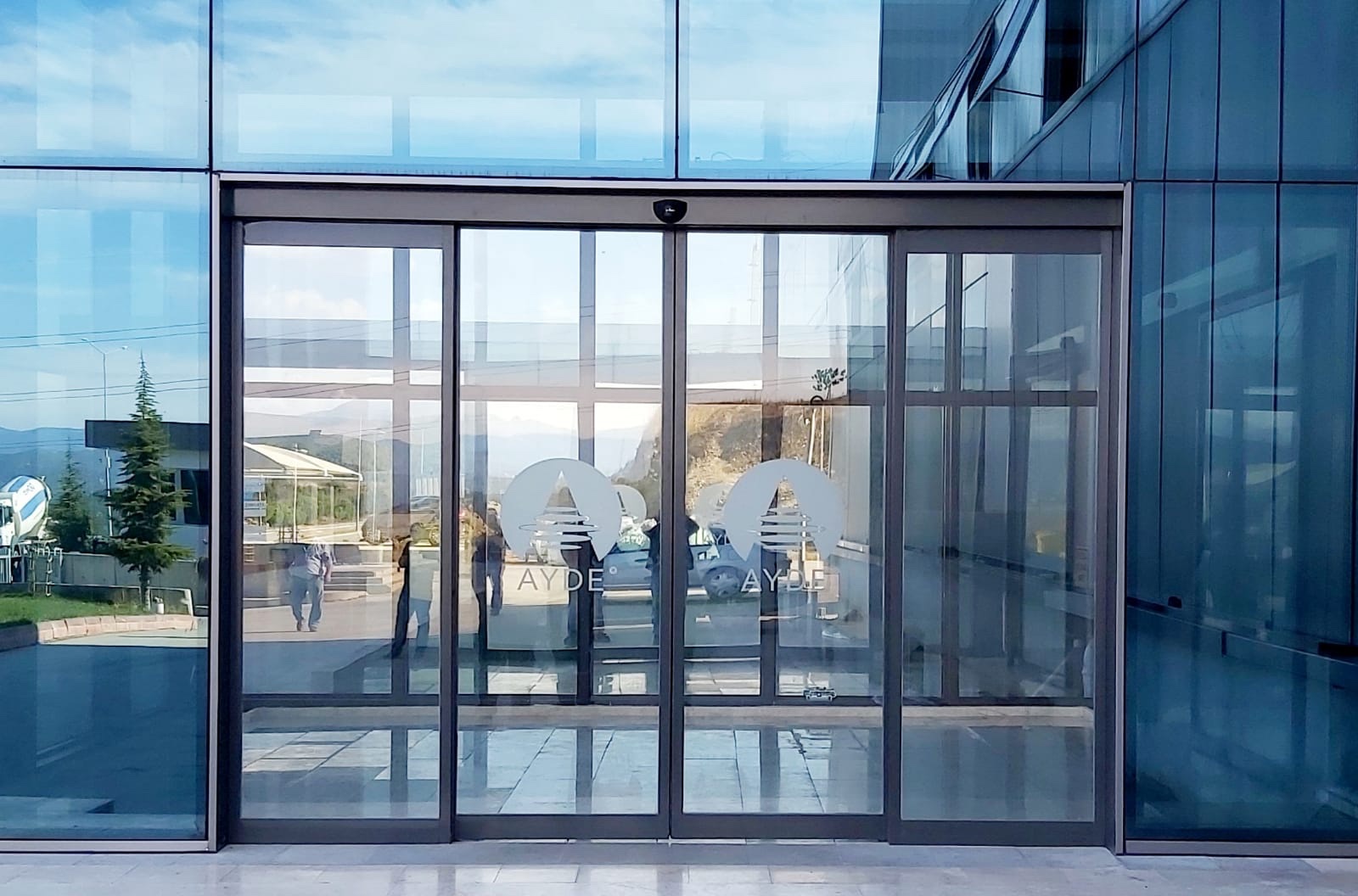
The r-tec automatic sliding door is documented for 120 + 120 kg in a double-leaf arrangement and 150 kg as a single leaf. The general brochure also mentions telescopic doors but provides no separate load or speed table for that variant. This sliding model lists R2 control, 230 VAC supply, a 24 VDC motor, 100 W power and IP23 protection.
Speed and performance
| Door type | Opening speed | Closing speed |
|---|---|---|
| Single-leaf (150 kg) | 90 cm/s | 70% of opening speed |
| Double-leaf (120 + 120 kg) | 180 cm/s | 70% of opening speed |
These manual specifications alone do not establish a time to open a particular passage or quantify a change in trapping risk. Anti-trapping sensitivity and braking distance are separate settings to assess at the installation site.
R2 control unit — 23 parameters
The R2 board enables fine tuning to the site with 23 separate parameters. Parameter groups:
- Opening settings (o1-o4) — Opening acceleration distance, opening speed, deceleration distance and push force.
- Closing settings (C1-C5) — Closing acceleration distance, closing speed, deceleration distance, push force and motor pressure after closing.
- Partial opening (o5) — Opening rate when partial mode is active (25% / 50% / 75%).
- Airlock (o6) — Synchronous operation between two consecutive doors.
- Hold-open time (t1) — 0–60 s in the R2 parameter table; the 2015 general specification’s 0–90 s is a different document scope.
- Electric lock (L1, L2) — Lock operation type and door movement delay after the lock engages.
- Photocell settings (F1, F2, Ft) — Photocell 1/2 active state and external/internal photocell selection.
- Battery and motor direction (b1, r1) — Behaviour on power loss and motor rotation direction.
- Remote control and service (Rf, S1, P1) — Remote mode, service interval and panic exit.
12 fault codes — fast fault detection
| Code | Meaning |
|---|---|
| o1 | Trapped while opening |
| o2 | Trapped while closing |
| o3 | Overcurrent protection |
| o4 | Button fault |
| o5 | Radar fault |
| o6 | Mechanical jam |
| o7 | Battery voltage low |
| o8 | Photocell fault |
| o9 | Mains voltage low |
| 10 | Encoder error |
| 11 | Overcurrent (>5 s) protection |
| St | Service time |
An R2 display code classifies a fault state and helps start diagnosis. The guide’s troubleshooting table lists more than one possible cause or check for some symptoms; a code alone does not establish the root cause or guarantee a repair time.
5 operation modes
Selector switch transitions:
- Hold open — The door is kept open.
- Partial opening — The R2 guide’s o5 parameter offers 25%, 50% or 75%. Confirm the selection for the actual installation.
- One-way exit — The one-way operating mode listed in the R2 guide.
- Automatic (standard) — Normal operation triggered by photocell/PIR sensor. Typical daytime operation.
- Hold closed — The door is kept closed; electric-lock operation is configured separately.
The qualified technical team verifies the selected mode and safety devices on the installed door. A mode name alone does not establish suitability for an evacuation application.
Archived document records and evidence boundary
- TÜV Austria record 16-PS-0009-TAT-21-MAD-2479 identifies the product as AUTOMATIC DOOR and the type/model scope as r-tec, open, con-tech. Renewed on 12 February 2021, it expired on 12 February 2022; it does not separately name the sliding door, R2 control or the leaf configurations on this page.
- SATSO / TOBB Domestic Product record 20221188100201 states a 100% rate only for AUTOMATIC DOOR and a validity period of 8 September 2022–8 September 2023. It gives no component-level scope for the motor, control or mechanical assembly.
Both are expired archive records. The model, control, equipment and current conformity file for the proposed sliding door are verified separately.
Field discipline
- Fix the mechanism securely to the wall and check its level, leaf adjustment and belt setting against the manual installation steps.
- Verify photocell and radar placement in the approved design for the selected door; this manual gives no universal 50 cm safety zone.
- Use the current installation and maintenance document for the exact model to set service intervals and select glazing.
Model notes
The linked manual covers installation and R2 settings. Match leaf load and site dimensions to the exact model drawing. It does not show a detailed sizing table or instructions for firmware updates via a boot stick.
In which sectors is it used?
This product family is preferred in the sectors and application areas below.
- Shopping centre entrance
- Hospital and healthcare facility
- Hotel lobby
- Office building
Frequently Asked Questions
Below we've compiled the most common questions and answers regarding this product.
-
Can the telescopic leaf-load limit be inferred from these figures?
No. The general automatic-door documents give 150 kg for a single leaf and 120 + 120 kg for a double leaf, but no separate telescopic leaf-load rating. Request the exact model table for a telescopic project.
-
Opening speed is given as 90 cm/s single and 180 cm/s double, so why is closing slower?
The product manual lists opening speeds of 90 cm/s for one leaf and 180 cm/s for two leaves, with closing speed at 70% of opening speed. These are speed specifications; the effectiveness of anti-trapping protection cannot be inferred from the ratio alone. The manual lists anti-trapping sensitivity and braking distance as separate adjustable settings.
Contact our team for model-specific information or a quote.