

Garage Door Motor Selection Guide — the r-tec PULL Family
Published:
Publisher: Alkur Kapı Sistemleri A.Ş.
In residential, villa and apartment shared garages, the comfort of a sectional door is completed by a correctly chosen motor. The r-tec garage door motors family covers this need with three models: PULL1000, PULL 1200 and PULL 1200L. All three share the same overhead (ceiling-mounted) architecture; what separates them is the pulling force class and the rail length. In this guide we explain step by step which model suits which door.
The three models at a glance
| Model | Pulling force | Rail | Max. door height | Typical use |
|---|---|---|---|---|
| PULL1000 | 1 000 N | Standard | 2.5 m | Residential and apartment garages |
| PULL 1200 | 1 200 N | Standard | 2.5 m | Heavy residential doors, small sites |
| PULL 1200L | 1 200 N | Long (3.7 m) | 3.1 m | High-ceiling and commercial garages |
What does pulling force actually tell you?
1 000 N is roughly the equivalent of 100 kg of force; however, this figure is not the full weight of the door but the extra load left to the motor after the spring balance has done its work. On spring-balanced sectional and tilting doors, the torsion spring carries most of the panel weight. For example, on a spring-balanced sectional garage door of 200-300 kg, the spring takes on 200-250 kg and only an extra load of 50-100 kg remains for the motor. That is why the PULL1000 is sufficient for a standard residential garage. For the applications that push the PULL1000 too hard — large sectional doors, apartment shared garages and small-facility doors — the reinforced variant of the family, the 1 200 N class PULL 1200, steps in.
Door height and rail length
- Door height up to 2.5 m — The standard-rail PULL1000 or PULL 1200 is suitable.
- Above 2.5 m, up to 3.1 m — The long-rail PULL 1200L is required; its console (rail) length is 3.7 m instead of the standard 3.1 m.
For the PULL 1200L a ceiling height of at least 3.7 m is recommended. A standard overhead motor protrudes 30-35 cm below the ceiling, and the rail length is calculated as the door height plus a 30 cm safety buffer. If the ceiling height is insufficient, the standard variant or an alternative motor solution should be considered instead.
Chain or belt?
On the PULL1000 and PULL 1200L, the drive chain or belt can be selected during installation; the PULL 1200 comes with a chain-mechanism console drive system. Chain is more durable and longer-lived but runs louder; belt is quiet yet requires replacement in 8-10 years. In residential applications where noise is critical, belt is recommended.
Shared equipment — standard on all three models
- 230 VAC mains supply
- Menu settings via LCD display (limit, speed, obstacle sensitivity)
- Integrated LED torch — entrance lighting for the driver
- Emergency release cord — manual opening during a power outage
- Obstacle detection + two photocell channels (opening + closing)
- 433 MHz rolling code remote receiver
- Soft start and soft stop
Before choosing: the spring balance check
Whichever model you pick, a garage door motor requires the door to be balanced by its own torsion spring system. A simple site test: the door is moved by hand to the 50 % open position; when released, it should stay there. If it drops or rises, the spring adjustment is faulty and the motor should not be installed. On a poorly balanced door the motor strains continuously, the thermal protection trips frequently and the chain or belt wears out quickly. That is why an authorised technician check before installation is mandatory.
Planning the door and the motor together
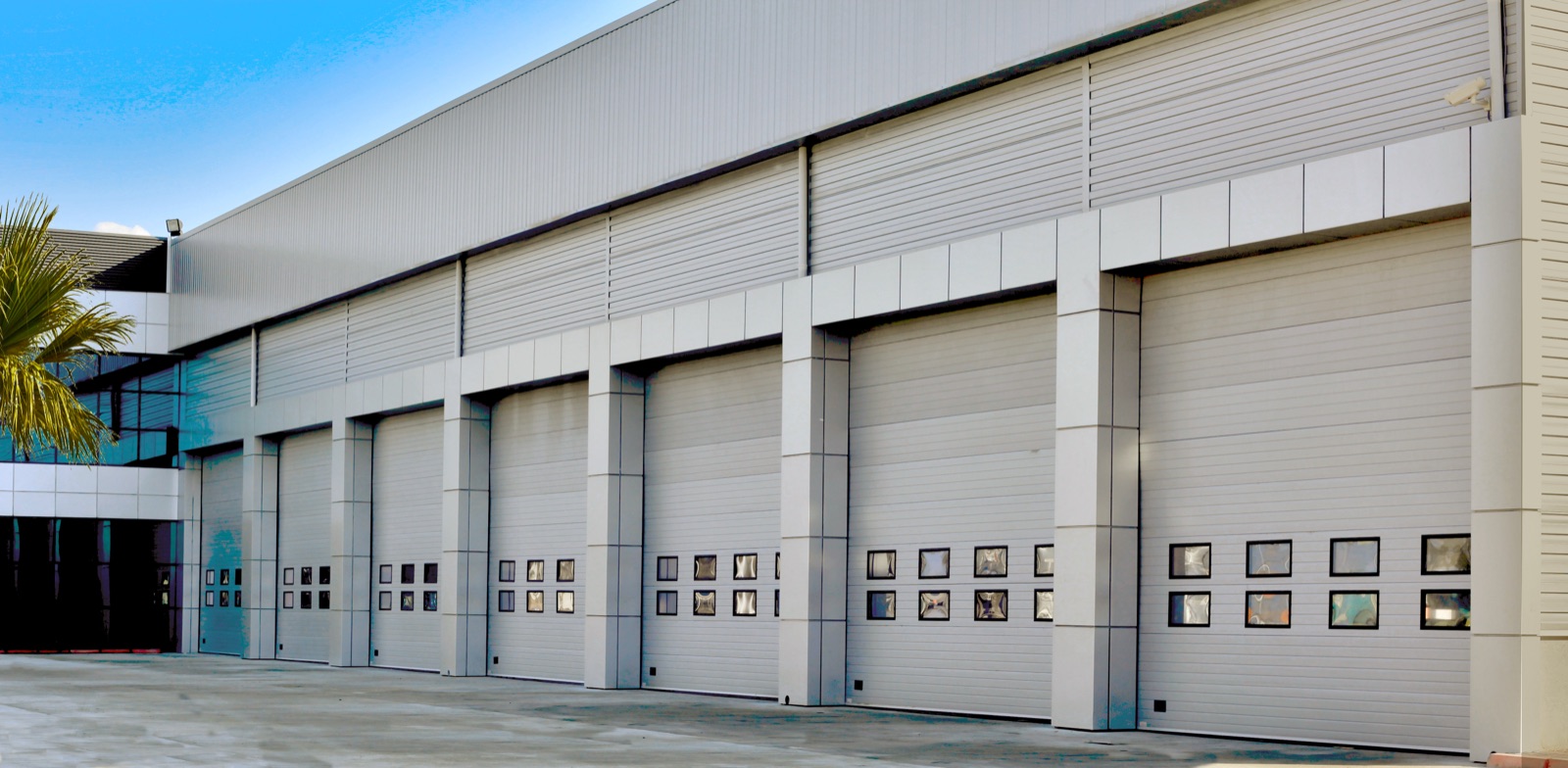
NORMTOR garage sectional doors are delivered ready for both manual and motorised use, with a 40 mm polyurethane-filled panel and torsion spring balance; in a standard residential garage they form a natural pair with the r-tec PULL1000. Industrial-size doors above 300 kg fall outside the PULL family’s class — for those sites, the combination of an industrial motor and the I-380 three-phase control unit is recommended.
In short, three questions are enough: how tall is the door, how heavy is it, and how many times a day will it open? If you have the answers, the model falls out of the table; if not, we’ll look at it together.