






Speed or Insulation? Engineering Trade-offs in Industrial Doors
Published:
Publisher: Alkur Kapı Sistemleri A.Ş.
By: Ercan Erdoğan
Speed, insulation, visibility and frequency of use answer different needs in door selection. Define the opening’s job before prioritising one feature; here we compare those decisions through NORMTOR, ALKUR HPVC and Full Vision.
Assess speed and insulation separately
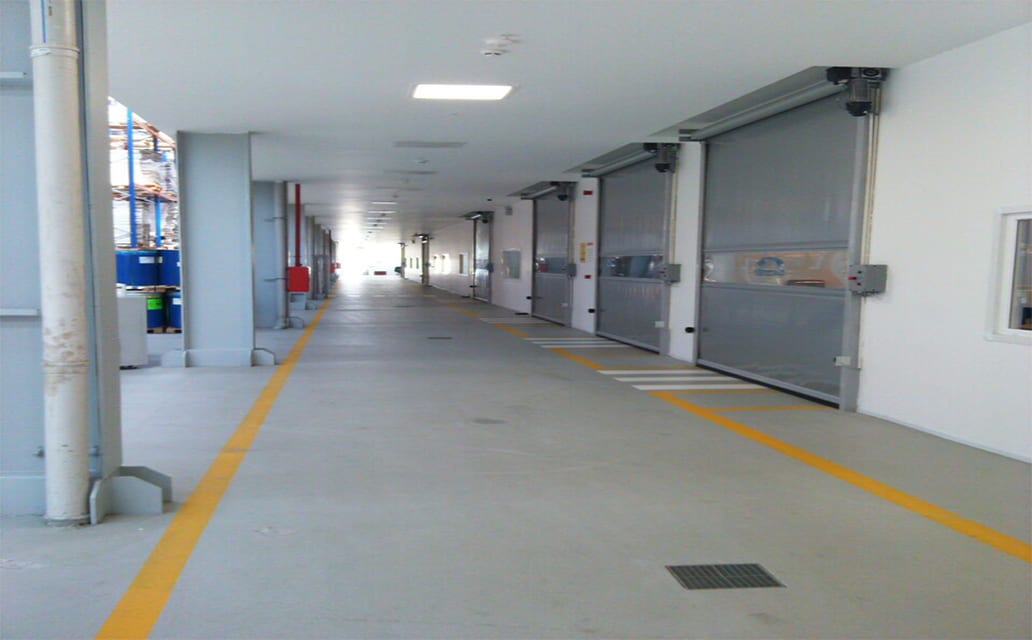
In an ALKUR high-speed PVC door, curtain movement, motor and control settings determine opening time. Relevant specifications give up to 1.5 m/s for inverter options; that upper value is not assumed for every installation.
For NORMTOR sectional doors, panels, seals and joints enter the insulation assessment. Insulation cannot be reduced to mass or speed to lightness alone. Air exchange while the door is open also belongs in the operating assessment.
Using two doors together can be considered for some projects. Layout, control sequence and actual operation need checking before claiming that this arrangement is more efficient.
The second axis: transparency versus heat
In showroom and car gallery projects, what the customer wants is clear: the interior should be visible even when the door is closed. NORMTOR Full Vision answers this wish with an aluminium frame and light-transmitting infill. The manufacturer’s REV03 specification describes a 1.3 mm profile wall and 3 mm single-sheet plexiglass or acrylic infill.
That document does not establish a double-wall version or a thermal performance value. Transparency and insulation therefore need separate checks: the proposed infill, frame and complete door configuration must be identified, and any thermal requirement compared with documentation for that configuration. The specification alone does not justify a comparison with single or double glazing.
The third axis: endurance versus cost
One trade-off stays invisible, inside the door itself. The torsion spring that carries a sectional door is designed for 15 000 cycles as standard, with 25 000, 50 000 and 100 000 cycle options available. The suitable cycle class depends on daily and peak use, the intended service period and the maintenance plan. Daily opening count alone cannot establish that an option is unnecessary or insufficient; a spring cycle class is not the calendar life of the complete door. The same logic applies to selecting the r-tec motor and control unit: the hardware is sized according to the door’s weight and daily cycle count.
The right answer is not “the most durable one” but the one that fits the usage profile — and striking that balance is precisely what engineering is for.
Solving the trade-off with a portfolio
The equations that no single product can solve, we solve with a product family. The ALKUR high-speed PVC door sits on the speed axis; r-tec automation completes every door with motor and control hardware sized to its usage intensity; NORMPANEL sandwich panels are the source of the insulation axis; the NORMTOR sectional families represent different balances of these axes; and NORMDOCK loading systems look after the dispatch line as a whole.
To evaluate together where your facility stands on these axes, you can get in touch with us by sharing your opening dimensions and usage profile; the right data turns these trade-offs into concrete answers for your own site.
Sources and evidence
Original sources for this publication and the specific information each link supports.
- NORMTOR Full Vision technical specification, REV03 (opens in a new tab) PDF language: TR / EN
- Publisher:
- Alkur Kapı Sistemleri
- URL
- alkur.com.tr
- Published:
- Last verified:
Claim supported: Page 2, clauses 2-4 and 2-6, describes the 1.3 mm aluminium profile and 3 mm single-sheet infill. It does not establish a double-wall variant or a thermal performance value.
- NORMTOR industrial door specification, torsion spring cycle classes (opens in a new tab) PDF language: TR / EN
- Publisher:
- Alkur Kapı Sistemleri
- URL
- alkur.com.tr
- Last verified:
Claim supported: PDF page 3 TR, clause 5-3 lists the standard 15 000 and optional 25 000, 50 000 and 100 000 spring cycle classes. These are not the complete door’s calendar life or a mandatory class for any given daily usage.