
Dock Leveler Selection Guide — Capacity, Platform and Shelter
Published:
Publisher: Alkur Kapı Sistemleri A.Ş.
When selecting a dock leveler for your facility, four decision points stand out: capacity class, platform size, lip type and dock-shelter pairing. This guide explains what to look at in each step, based on the NORMDOCK dock leveler product data. NORMDOCK is Turkey’s first domestic CE-certified dock leveler and complies with the EN 1398 European standard.
Capacity class: 6 tons or 9 tons?
NORMDOCK levelers are produced with a 6,000 kg dynamic + 9,000 kg static load capacity. The capacity sets the minimum safety limit for the maximum load (forklift + carried load) that will pass over the leveler:
- For operations running with standard pallets and light forklifts, 6 tons is usually sufficient.
- For facilities with heavy forklifts (4-5 ton class + load) or container traffic, the 9-ton class is selected.
Sharing your forklift’s technical label and your daily load profile together with your quotation request makes the correct capacity selection easier.
Platform size and pit preparation
Two standard platform sizes are offered:
- 2,000 × 2,500 mm — compact operation, saves space.
- 2,000 × 3,000 mm — for long forklift brackets and pallet manoeuvring; a wider platform requires less manoeuvring.
The recommended rise/fall height range is +32 / -32 cm; a wider height range requires custom manufacturing. Pit detail drawings for both sizes are provided as PDFs so the leveler pit can be prepared correctly at the construction stage.
Lip type: Hinged or telescopic?
| Feature | Hinged-lip | Telescopic |
|---|---|---|
| Operating principle | Front leaf (flap) tips from above | Lip slides forward from below |
| Flap / Lip length | 300 – 400 mm | 600 mm standard / 1,000 mm optional |
| Platform plate | 6 – 8 mm teardrop | 8 – 10 mm teardrop |
| Vehicle bed reach | Short-medium distance | Distant point (trailer even 1 m away) |
| Typical use | Fleet with fixed bed size | Different trailer depth — flexible scenario |
In a logistics fleet with fixed bed sizes, the hinged-lip type is sufficient; in flexible scenarios with different truck and trailer sizes and a distant load point, the telescopic type is required. The hinged-lip type also comes with a Single Leaf or 3 Leaf (1+2) option: single leaf operates faster for standard dispatch, while three leaves allow vehicles of different heights to be aligned across a wide range.
Hydraulic system and safety equipment
Whichever type you choose, the drive and safety package is standard:
- Motor: 380 V three-phase / 50 Hz / 1 HP (0.75 kW).
- Solenoid valve: The leveler does not drop down during a power outage; it remains fixed.
- Control unit: IP54 protection — resistant to dust and water splash.
- Operating temperature: -10 °C / +40 °C; maximum noise 70 dB.
- Safety: Finger-protection mechanism, maintenance safety bar and an anti-slip teardrop steel platform surface.
Dock-shelter pairing: A complete loading line
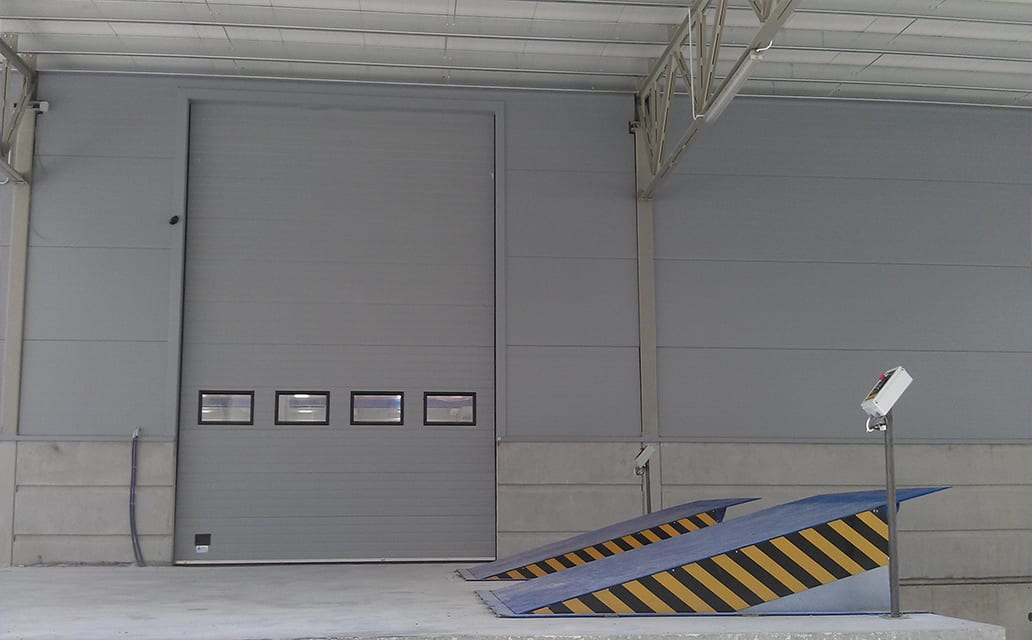
The leveler bridges the level difference between the vehicle and the floor; the NORMDOCK dock shelter surrounds the vehicle’s trailer to form a semi-enclosed buffer zone that isolates the loading area from outside weather. The two systems complement each other.
The shelter’s standard size is 3,400 × 3,450 × 620 mm; production up to 4,200 × 4,500 × 1,000 mm is possible for special projects. The PVC fabric compliant with the DIN 53352 / 53356 / 75200 standards (3 mm thickness, 900 g/m² density) is anti-static and stain-resistant, making it suitable for food, pharmaceutical and beverage facilities and lines requiring HACCP/GMP hygiene control. In cold storage applications it reduces temperature loss and saves energy.
One last reminder
The most expensive mistake in leveler selection is made not at purchase but at construction: a badly prepared pit. So whichever model you choose, get the pit detail drawings to your construction team early — the PDFs are ready on the product page. For everything else, the Loading Systems page and our contact form are at your service.