





Documents
All documents open as PDFs in a new tab.
Technical specifications
1Dimensioning forms
1Installation guides
1Key technical specifications
The most critical technical parameters of this product.
- Material Panama-weave imported PVC
- Curtain weight 900 g/m²
- Joining fabric sections Fabric sections joined with Ø25 mm galvanised tubes
- Transparent section Optional, any desired size
- Side post 200 × 200 mm galvanised steel
- Drum Ø114 mm tube
Show all technical specifications (14)
Construction
| Feature | Value |
|---|---|
| Side bearings | 3 mm special laser-cut, galvanised |
Motor
| Feature | Value |
|---|---|
| Voltage | 380 V 3-phase or 230 V single-phase |
| Standard (without inverter) speed | 0.60 – 0.70 m/s |
| Inverter speed | 1.5 m/s |
| Motor series | RAPID 35 / 45 / 75 / 85 / 180 Nm (according to door size) |
Control
| Feature | Value |
|---|---|
| Control unit (without inverter) | I-380 (3-phase control) |
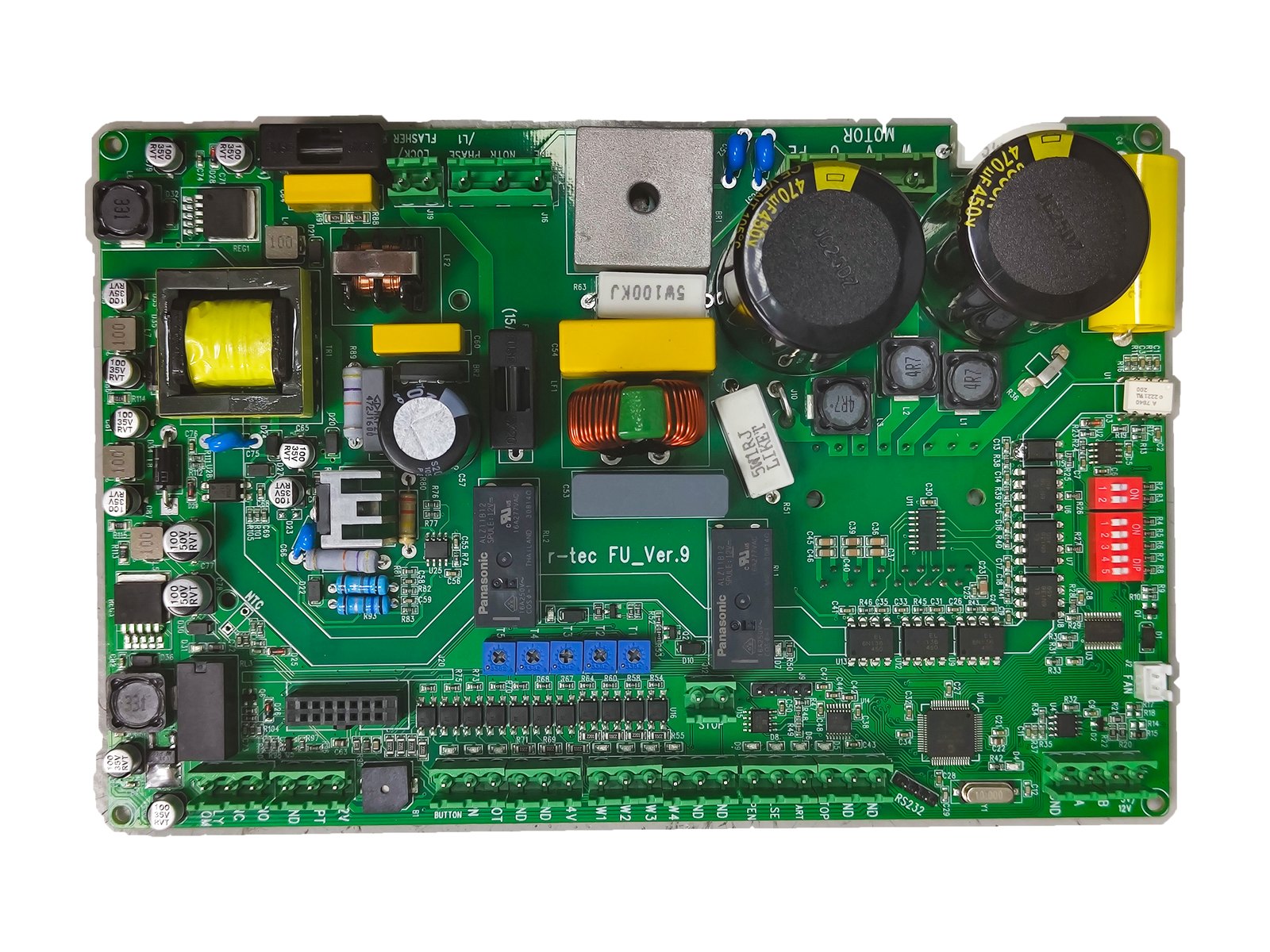
| Control unit (with inverter) | FU (frequency inverter) |
Safety
| Feature | Value |
|---|---|
| Safety | Full-height photocell or safety photocell |
Videos
Overview
Rapid PVC doors enable the entry-exit of transport vehicles such as forklifts with high opening-closing speed and also establish insulation against factors such as odour, heat, dust and wind between spaces. In the folding type, the fabric folds and gathers above the opening; the section in the dimension verification form places the gathering space at the top. Unlike the high-speed roll variant, it has galvanised steel 200 × 200 mm side posts + Ø25 mm tube reinforcement and is considered for wide openings and wind-exposed indoor or outdoor projects.

Folding vs High-speed roll — construction difference
The roll-up and folding types have different post and curtain structures. Their suitability for a site depends on the measured opening and wind load.
| Feature | High-speed roll | Folding |
|---|---|---|
| Side post | 80 × 80 mm aluminium (RAL 9006) | 200 × 200 mm galvanised steel |
| Drum | Ø125 mm aluminium | Ø114 mm tube |
| Fabric reinforcement | None | Ø25 mm galvanised tube lines |
| Opening | Sized for each project | Considered for wide openings |
| Aesthetics | Sleek aluminium (indoor) | Industrial (outdoor) |
| Speed (without inverter) | 0.65 – 0.70 m/s | 0.60 – 0.70 m/s |
| Speed (with inverter) | Up to 1.5 m/s | Up to 1.5 m/s |
→ There is no single width threshold for choosing a type. Check the opening, headroom and side clearances, use and wind load together.
Structural features
- Side post — 200 × 200 mm galvanised steel. Suitability for wind load is assessed against door dimensions and site conditions.
- Upper tube and gathering space — the technical specification lists a Ø114 mm tube; the dimension form shows the folding fabric gathering above the opening.
- Joining fabric sections — specification §3-2 describes fabric sections of different widths joined with Ø25 mm galvanised tubes according to the door height. Verify their arrangement on the project drawing.
- Side bearings — 3 mm special laser-cut galvanised. Aesthetics + mechanical protection together.
- Fabric — 900 g/m² panama-weave imported PVC; same material as the high-speed roll. Transparent window optional.
Motor + control selection
The folding HPVC specification lists two speed configurations:
- Without inverter: 0.60 – 0.70 m/s.
- With inverter: up to 1.5 m/s.
The FU manual describes soft start/stop and encoder terminals. Those general controller functions alone do not establish a pairing with a particular RAPID motor or door size; confirm the final motor-controller selection for the project.
Target projects
- Industrial ramp entrances — Wide openings with high open-close cycles, exterior façade.
- High-ceilinged warehouses with air loads — Wind currents + high volume.
- Semi-open production lines — Separation between open production area and indoor space.
- External façade loading doors — Logistics facility truck ramp entry.
- Ports + shipyards — Heavy wind-loaded sites.
- Wide-opening logistics facilities — verify the opening and installation clearances for the project.
- Agriculture + livestock facilities — Outdoor + large vehicle transit.
- Cold storage wide openings — When the high-speed roll is insufficient.
Evidence scope
The conformity file for a folding HPVC door is verified against the proposed dimensions and hardware combination. The archived 2010 TÜV NORD cover identifies a Type ECO high-speed foil door with an Mtec drive and is only page 1 of a 13-page report. The old EAC copy identifies NORMTOR products, not ALKUR HPVC. Neither historical record is transferred to the folding variant as evidence of performance or current market conformity.
Field discipline
- Opening size and installation clearances — record these on the dimension verification form; our dealers assess the suitable roll-up or folding variant for the project.
- Wind load — Assess it together with the door size and site conditions; set the curtain reinforcement layout from the approved project drawing.
- Mains — The door specification lists 380 V three-phase and 230 V single-phase options; verify compatibility with the selected motor-controller package.
- Fabric wear — In the folding geometry, fatigue may occur at the lower + upper joint points of the fabric; in periodic maintenance, fabric + joint profile + tube reinforcement check is carried out.
- Periodic maintenance — Set intervals and inspection points using the selected equipment’s current maintenance instructions and site conditions.
Model notes
The folding type is considered for wide openings or wind-exposed sites. When choosing between it and the ALKUR High-Speed Roll Type HPVC, assess the opening, installation clearances and site conditions rather than applying a fixed 5 m threshold. Confirm the final model, motor and evidence scope for the project configuration.
In which sectors is it used?
This product family is preferred in the sectors and application areas below.
- Food production facility
- Cold store passage
- Pharmaceutical and cosmetics production
- Logistics internal passage
- Automotive supply industry
Frequently Asked Questions
Below we've compiled the most common questions and answers regarding this product.
-
How do we decide between the folding type and the high-speed roll type HPVC?
The folding type's 200 × 200 mm galvanised steel side posts and Ø25 mm tube reinforcement are considered for wide openings and wind-exposed sites. The technical documents do not define a fixed 5 m threshold between the two types; you can determine the suitable variant with our dealers using the opening dimensions, installation clearances, wind load and dimension verification form.
-
What is the opening speed of the door and how is the motor selected?
The folding HPVC specification gives 0.60 – 0.70 m/s without an inverter and up to 1.5 m/s with an inverter. Motor and controller are selected together for the door size and required speed; this specification does not include a RAPID motor-controller pairing table.
-
Which control unit and mains voltage are used?
The door specification lists 380 V three-phase and 230 V single-phase configurations. The separate FU manual specifies a 220 V single-phase input and three-phase motor output, but gives conflicting 3 × 220 V and 3 × 230 V output values on the same page, so no exact output voltage is claimed. Its encoder terminals do not mean every motor has an integrated encoder. Check the motor, controller and mains pairing against approved project documents.
-
Is a transparent window option available and what fabric is used?
The fabric is the same 900 g/m² panama-weave imported PVC material as the high-speed roll type. A transparent window of any desired size is optional, providing visibility and safety on the industrial site.
-
How is the evidence scope verified for a folding HPVC door?
The conformity file is checked against the proposed dimensions, supporting structure, fabric, safety equipment, motor and controller. The archived 2010 Type ECO report cover and the old EAC record issued for NORMTOR do not automatically apply to a folding HPVC door.