






Technical files
Documents
Specifications and installation information can be viewed or downloaded as PDFs from our server.
User manuals
1Key technical specifications
The most critical technical parameters of this product.
- Maximum charging power 22 kW
- Three-phase input / output current 400 V AC / 32 A
- Vehicle connection Type 2
- Protection class IP54
- Installation Wall-mounted (1.00–1.45 m)
- Residual-current protection External 30 mA RCD (supply panel)
Videos
You can find all of our product and installation videos on our YouTube channel.
Visit Our YouTube ChannelOverview
WCU-22 Wallbox is a fixed wall-mounted AC charger. Its manual’s specification table gives up to 22 kW at 400 V three-phase input and 32 A output. It specifies a Type 2 vehicle connection and IP54 enclosure rating. The device has no internal residual-current protection; an external 30 mA RCD is required in the supply panel.
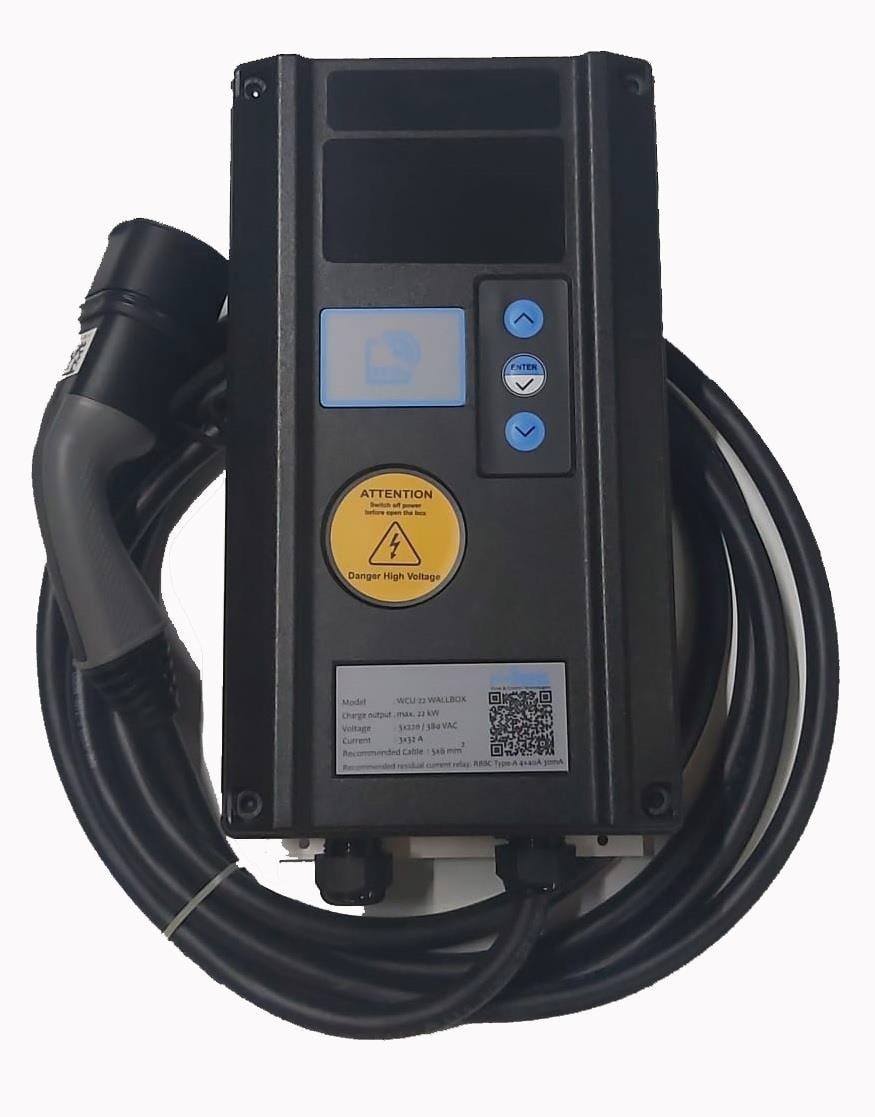
Power and vehicle compatibility
22 kW is the unit’s maximum rating. It does not mean that every vehicle can accept that power or reach full charge in a fixed time. The project’s vehicle AC charging capacity and site supply are evaluated together. No fixed full-charge time or infrastructure cost ratio against DC charging is claimed.
Multiple units
For multiple WCU-22 units, assess the total possible load against the site’s electrical capacity. The manual lists some communication methods as optional; this does not establish load management on every delivered unit. Confirm the needed hardware and control design for the ordered configuration.
Installation and protection
For 22 kW at 400 V three-phase/32 A, the WCU-22 manual’s table for a run under 50 m lists 5 × 6 mm² cable, a 40 A Type C breaker and a 30 mA Type A RCCB. These are conditions of that table; final selection follows circuit length, voltage drop, earthing and the site’s electrical design. The RCD belongs in the panel, not inside the charger. The manual gives a wall mounting height of 1.00–1.45 m. A competent electrician installs the unit under the applicable electrical rules.
In which sectors is it used?
This product family is preferred in the sectors and application areas below.
- Commercial car park
- Office and plaza garage
- Corporate fleet parking
Frequently Asked Questions
Below we've compiled the most common questions and answers regarding this product.
-
How is the WCU-22 supply circuit selected?
The manual specifies 400 V three-phase and 32 A for 22 kW. Its table for a run under 50 m lists 5 × 6 mm² cable, a 40 A Type C breaker and a 30 mA Type A RCCB. That table is conditional, not a design for every site; a competent electrician checks cable sizing, voltage drop, earthing and protection for the project. The device has no internal RCD.
-
Will 22 kW fully charge every vehicle in the same time?
No. The manual's 22 kW is the unit's maximum output. A full-charge time cannot be stated without the vehicle's onboard AC charger rating, battery and charge state.
Contact our team for model-specific information or a quote.