





ALKUR HPVC — The Story and Today of Turkey's First Domestic Rapid PVC Door
Published:
Publisher: Alkur Kapı Sistemleri A.Ş.
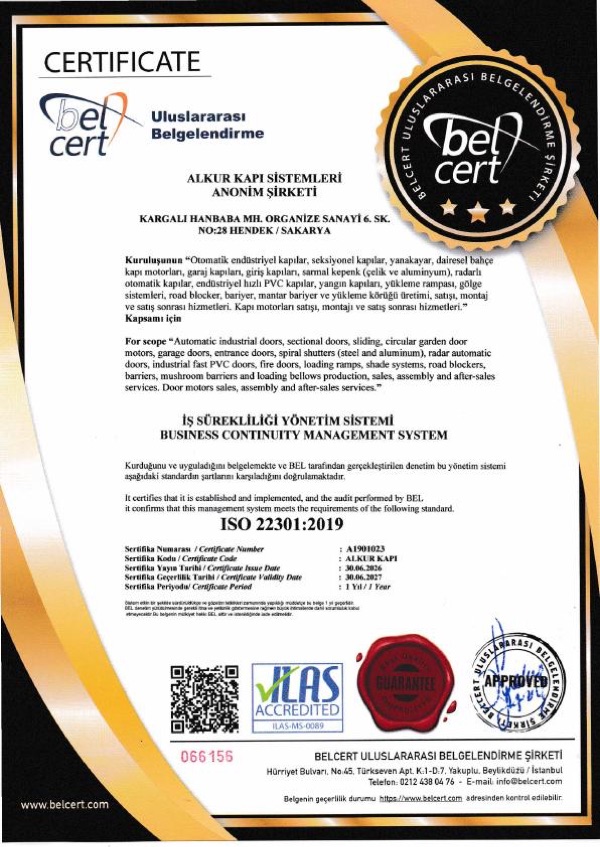
In the last months of 2008, in our 1,500 m² factory in Tuzla, we made a decision: we would manufacture Rapid PVC (HPVC) door technology — which had been imported until then — ourselves in Turkey. A year later, on 29 October 2009, the doors of our new 5,000 m² factory in Hendek/Sakarya Organised Industrial Zone opened; in the same year we received the title of Turkey’s first TÜV NORD CERT certified domestic HPVC door manufacturer.
Today — sixteen years have passed since the opening. In this piece we focus on the technical foundations of the ALKUR HPVC product family, the reasons it has become indispensable for which sectors, and how it integrates with our current motor portfolio.
Why is HPVC necessary?
When opened, a standard industrial door exchanges a 2-3 metre tall column of air with the outside. For a cold storage, this means lost BTU; for a pharmaceutical clean room, contaminated air flow; for an automotive line, thermal shock.
The HPVC door solves this problem in three ways:
- Opening speed — 1.5-2 m/second movement; that is, a 3-metre door opens fully in 2 seconds
- Closing speed — automatically closes the moment the transit is complete, air exchange is minimum
- Flexible fabric body — does not shatter when struck lightly; comes off the rail after impact and is manually replaced
When these three features come together, a balance of energy savings + operational efficiency + safety is achieved. The technology, widely used in Europe for decades, was only accessible in Turkey through imported options before 2009.
ALKUR HPVC — two main types — high-speed roll and folding
There are two basic constructions in our product family:
High-speed roll (rolling)
The fabric wraps over a Ø 140 mm aluminium drum at the top. Takes up little space, low conflict with overhead installations. Typical use:
- Cold storage entrance — tight corridor, side equipment
- Pharmaceutical clean room — hygiene + controlled air flow
- Automotive assembly line — high-frequency transit
Folding
While opening, the fabric folds and settles into the upper housing. Larger openings and a lighter installation. Typical use:
- Logistics warehouse internal corridor
- Food distribution centre
- Wide production area sections
In both types, 900 g/m² panama-weave PVC fabric is common — anti-static, stain-resistant, washable. With 6 RAL colour options, corporate colour harmony is provided.
Motor portfolio — the RAPID family
The r-tec RAPID motor series we integrate specifically for ALKUR HPVC comes with 5 different torque options:
| Model | Torque | Opening | Typical Cycle |
|---|---|---|---|
| RAPID 35 | 35 Nm | Small (≤2.5 m) | Low-medium |
| RAPID 60 | 60 Nm | Medium | Medium |
| RAPID 90 | 90 Nm | Medium-large | Medium-high |
| RAPID 120 | 120 Nm | Large | High |
| RAPID 180 | 180 Nm | Very large | Very high |
Motor selection should consider not only the opening size but also the number of transits per minute and the wind resistance class. For the motor’s thermal tolerance in high-frequency applications, we recommend a torque class one level up.
Control board — FU or I-380
Motor drive control can be done in two main ways:
FU — inverter-based, versatile
An HPVC drive board with a power of 2,200 VA, from a 220 V single-phase input to a 3×230 V three-phase output. Field calibration can be done quickly with 5 trim pots + 5 DIP switches. Practical advantage: inverter-based control is obtained at a single-phase supply point.
I-380 — three-phase direct drive
Direct drive at a 380 V three-phase supply point. 1.5 kW maximum power. Current and phase protected, for heavy industrial use.
Which board to choose depends on the facility’s electrical infrastructure; it would not be right to give a definite recommendation without knowing the supply point.
Certification — TÜV NORD CERT 2009
Our ALKUR HPVC product family ships with two main certificates:
- TÜV NORD CERT Quality Certificate (2009 — for Turkey’s first domestic HPVC)
- EAC Eurasian Conformity Certificate — direct export to Eurasian markets
The TÜV NORD CERT certificate shows not only the production discipline; it also demonstrates that mechanical resistance, transit speed, insulation and safety parameters have been tested by an independent German-origin auditor. This is the fundamental compliance proof for export to the European market.
Today — which investments are coming?
With the addition of the EV charger to the r-tec product range in 2024, we are also working on new motor variants on the HPVC side; especially in the low-torque high-cycle segment, a model below the current RAPID 35 is in the evaluation phase. As the intensity of use on production lines increases, motor life becomes critical.
For detailed product specs, motor compatibility table and the PDF technical specification, visit the Products > HPVC Doors > ALKUR HPVC page; for project information and a price quotation, you can reach us via our contact form.