

Speed or Insulation? Engineering Trade-offs in Industrial Doors
Published:
Publisher: Alkur Kapı Sistemleri A.Ş.
In engineering, every design is a choice; when you strengthen one property, you usually give something up in another. Industrial doors are no exception to this rule. To the question “Which door is the best?” we have been giving the same answer for more than thirty years: Best at what? In this essay we want to walk through the three fundamental trade-offs behind door selection — speed versus insulation, transparency versus heat, endurance versus cost — through an engineer’s eyes.
The first axis: speed versus insulation
What makes a door fast is its lightness. The flexible curtain of the ALKUR high-speed PVC door reaches an opening speed of 1.5 m/s in the inverter-driven model; the forklift operator never waits in front of the door, and internal traffic keeps flowing. But that same curtain, by its nature, cannot offer the thermal resistance of a sandwich panel.
What makes a door insulated, on the other hand, is its mass. The 40 mm polyurethane-filled panel of the NORMTOR sectional door, with its 40 kg/m³ foam density, holds back heat and sound; but carrying, folding and balancing that panel takes time — no sandwich panel door can reach the speed of a flexible curtain.
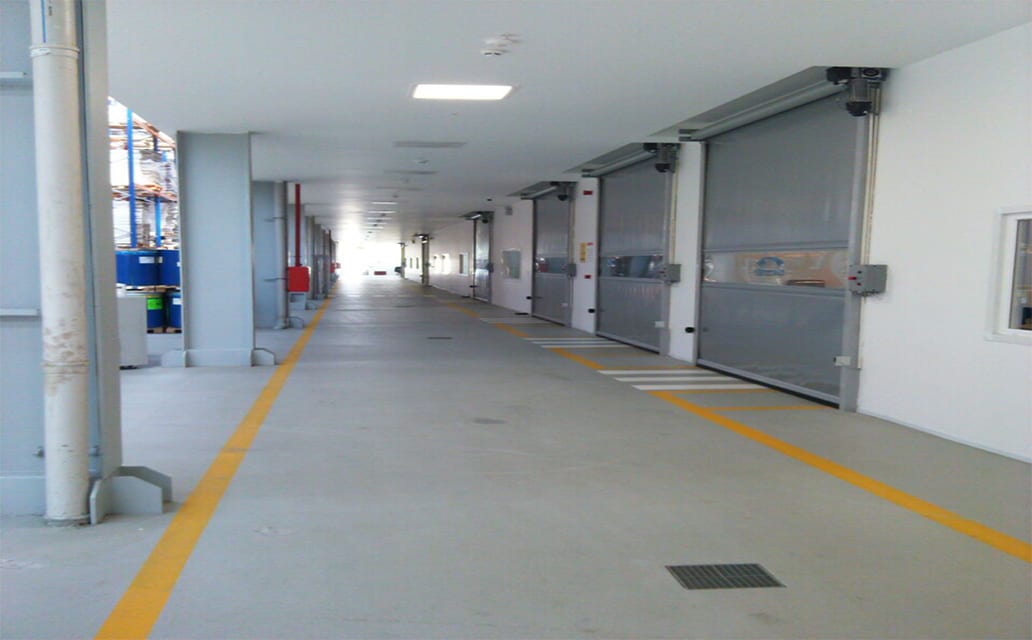
Because these two properties cannot be maximised in the same body, the right engineering answer is often to use two doors together: a sectional door on the external facade for insulation and security, and a high-speed PVC door at the internal passage for speed and hygiene. We compared this combination in detail in a separate guide.
The second axis: transparency versus heat
In showroom and car gallery projects, what the customer wants is clear: the interior should be visible even when the door is closed. NORMTOR Full Vision answers this wish by combining an aluminium frame with a 1.3 mm wall thickness and 3 mm plexiglass infill. But transparency is not free either: in its thermal behaviour, the single-wall structure resembles a single-glazed window.
There is a middle point that softens this trade-off: the double-wall Full Vision, with an air gap between two layers of plexiglass, offers insulation similar to a double-glazed window. Not the comfort of a full sandwich panel — but the most balanced solution you can reach without giving up the shop-window effect.
The third axis: endurance versus cost
One trade-off stays invisible, inside the door itself. The torsion spring that carries a sectional door is designed for 15 000 cycles as standard, with 25 000, 50 000 and 100 000 cycle options available. For a door that opens ten times a day, a 100 000-cycle spring is an unnecessary investment; for a dispatch door that opens hundreds of times a day, the standard spring tires early. The same logic applies to selecting the r-tec motor and control unit: the hardware is sized according to the door’s weight and daily cycle count.
The right answer is not “the most durable one” but the one that fits the usage profile — and striking that balance is precisely what engineering is for.
Solving the trade-off with a portfolio
The equations that no single product can solve, we solve with a product family. The ALKUR high-speed PVC door sits on the speed axis; r-tec automation completes every door with motor and control hardware sized to its usage intensity; NORMPANEL sandwich panels are the source of the insulation axis; the NORMTOR sectional families represent different balances of these axes; and NORMDOCK loading systems look after the dispatch line as a whole.
To evaluate together where your facility stands on these axes, you can get in touch with us by sharing your opening dimensions and usage profile; the right data turns these trade-offs into concrete answers for your own site.
